Not sure which template is right for you? Customize yours in 2 minutes — we match it to your income, expenses, and goals.
A family budget template should do more than total bills. It should help a household see what money is coming in, what has already been committed, what is flexible, and which costs are easy to forget until they blow up the month. That is why a proper family budget spreadsheet looks different from a solo monthly budget.
Once two adults, children, shared goals, or uneven income streams enter the picture, a blank worksheet stops being enough. You need structure. You need a system that makes shared decisions visible without turning the budget into a second job. That is the real purpose of a family budget template, and it is why NestBudget's Family Template exists.
This guide explains how to build a household budget template Excel workflow that works in euros or dollars, how to manage a multi-income budget without confusion, what categories actually belong in the sheet, and how couples can keep the budget current without endless money meetings. If you still need a free starter for one person, see the Google Sheets free roundup.
Why a family budget template works better than a blank sheet
A blank sheet assumes you already know what the household needs to track. In reality, most families miss the same things at first: irregular costs, personal spending boundaries, and the difference between money that is shared and money that is not. A good family budget template makes those categories visible immediately.
That clarity matters because budgeting tension rarely starts with math. It starts with uncertainty. One person thinks there is room to spend. The other thinks a school payment, insurance renewal, or car repair is around the corner. The spreadsheet has to reduce that ambiguity.
Advice from NerdWallet and the CFPB both reinforce the same point: a budget only works if the household can revisit it regularly. That is much easier when the sheet already has the right structure.
The categories every family budget template should include
The categories in a family budget template should reflect how households actually spend money. Start broad enough to stay manageable, but not so broad that the tradeoffs disappear. The easiest way to think about it is in five groups: income, fixed bills, flexible household costs, goals, and personal spending.
| Category group | Examples | Why it matters |
|---|---|---|
| Income | Salary 1, salary 2, side income, child support, reimbursements | Shows stable versus variable money coming in |
| Fixed household bills | Rent or mortgage, utilities, insurance, debt payments, subscriptions | Clarifies the money already committed before flexible spending begins |
| Flexible household costs | Groceries, transport, eating out, school costs, pet care | These are the lines most likely to drift during the month |
| Goals and sinking funds | Emergency fund, holiday fund, repairs, travel, birthdays, back-to-school | Protects the budget from predictable but irregular expenses |
| Personal spending | Personal allowance, hobbies, clothes, coffee, independent subscriptions | Reduces arguments by making individual freedom explicit |
Families usually improve their budget fastest by separating shared and personal spending instead of blending everything together. That does not mean couples must split every line. It means the spreadsheet should make it clear what the household is managing jointly and what each person controls independently.
How to structure a family budget template with multiple incomes
A multi-income budget becomes confusing when the workbook only shows one total income number. That hides too much. The better approach is to list every income source separately, then subtotal stable income and variable income before moving to expenses.
For example, one partner's salary may be fixed while the other person's freelance income varies. If you collapse both into one line, it becomes harder to decide which expenses should be funded from the reliable base and which ones depend on good months. Separate lines make that judgment easier.
- List every income source on its own row.
- Flag which income is dependable and which is variable.
- Budget core bills against dependable income first.
- Use variable income for goals, debt payoff, or extra cushioning.
- Keep one notes column for pay-date or irregularity reminders.
This is one place where a purpose-built household budget template Excel file beats a blank sheet. The layout already expects more than one income earner, so the budget stays readable instead of becoming a patchwork of extra rows.
How to handle irregular household costs without breaking the month
Irregular costs are the reason many families feel like they are always “off budget” even when their daily spending is fairly reasonable. The fix is not guesswork. The fix is a sinking-fund section inside the family budget template.
Think about the costs that do not happen every month but are still inevitable: school supplies, holiday travel, home repairs, car maintenance, children's activities, annual subscriptions, gifts, and medical extras. These should each get a small monthly allocation. When the expense arrives, the money is already waiting for it.
This is the difference between a family budget spreadsheet that reports the past and one that protects the future. A good family template should leave room for those less frequent categories from the start.
How couples can use a family budget template without arguing over every line
Couples do not need perfect agreement on every category. They need a repeatable process. The budget gets calmer when the spreadsheet answers the same few questions every week: What changed? What is off plan? What bill is coming next? Do we need to move money from one category to another?
In practice, the cleanest setup is usually:
- Shared categories for shared obligations.
- Personal spending lines for individual flexibility.
- One agreed review day each week.
- One agreed rule for unexpected income, such as splitting it between goals and breathing room.
This is where a family budget template becomes more than a file. It becomes a decision-making tool. The more obvious the categories are, the less emotional friction there is around the numbers.
How to review a family budget template every week
Weekly review is the habit that keeps the family budget template alive. A household budget should not be a once-a-month autopsy. It should be a short meeting with simple questions and quick updates.
- Enter or check the latest actual spending and income.
- Compare each flexible category against plan.
- Look at the next 7 to 14 days of bills and family events.
- Adjust one or two categories before they drift too far.
- Check savings goals and sinking funds before ending the review.
Ten to fifteen minutes is often enough. The point is not to discuss every coffee or grocery receipt. The point is to keep the family budget spreadsheet current enough that small course corrections still matter.
Why NestBudget's Family Template is the fastest option for real households
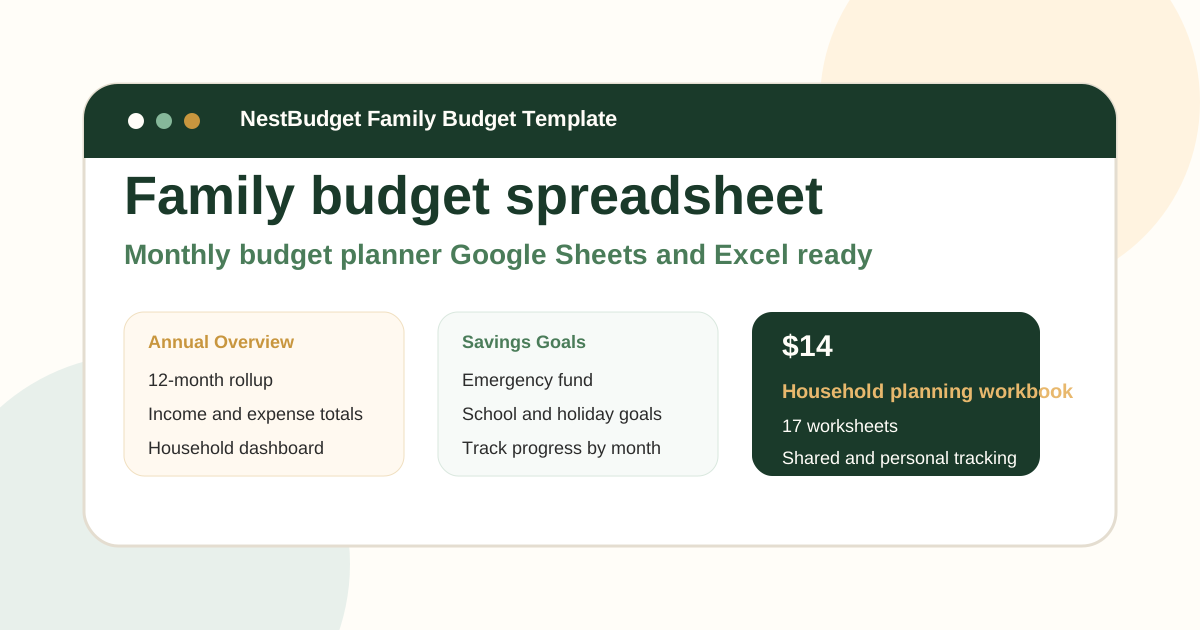
A generic template can teach you the logic of budgeting. A dedicated family workbook helps you keep going. The NestBudget Family Template is built around the problems families actually run into: multiple income earners, recurring household costs, savings goals, annual planning, and categories that need to change over time.
Instead of forcing one compromise view, it gives you a structure designed for shared finances. That makes it a better fit than trying to stretch a solo monthly budget across a whole household. And because it is still a spreadsheet, you keep the control that many families want from Excel or Google Sheets.
- Multiple income lines built into the logic.
- Annual overview for long-range household visibility.
- Savings goals and category controls in the same workbook.
- One-time price instead of recurring app fees.
- Google Sheets compatibility for shared access.
If your household wants both a shared family workbook and a separate solo budget view, use the Bundle so you do not have to choose between the two workflows.
Common mistakes families make with their household budget template Excel setup
- Using one total income number instead of separating each source.
- Ignoring irregular costs until they hit the checking account.
- Combining all personal and shared spending into one vague category list.
- Reviewing the budget only after the month is already over.
- Trying to make a solo spreadsheet handle a whole household forever.
Most of these are structure problems, not effort problems. Fix the template and the budgeting habit usually becomes easier to maintain.
Conclusion: choose the right family budget template for your household
The right family budget template gives your household one shared view of income, bills, goals, and flexible spending without turning budgeting into admin work. If the spreadsheet makes it easy to update categories, track multiple incomes, and review the next few weeks, you are much more likely to keep using it.
For families that want the fastest route to that outcome, the NestBudget Family Template is the strongest next step. It gives you the structure most households eventually build anyway, but without making you invent every part of the system yourself. If you want to compare free starting points first, go back to the Google Sheets free guide or review the broader Excel template comparison.
FAQ: family budget template
What should a family budget template include?
It should include multiple income lines, fixed and flexible expenses, sinking funds, personal spending, and a clear planned-versus-actual view.
How do couples budget with different incomes?
They usually do best by listing each income separately, funding core household bills from dependable income first, and agreeing on how personal spending is handled.
What is the best household budget template Excel option?
The best option is a workbook built for multiple incomes and recurring family costs, which is why NestBudget's Family Template is a strong fit.
Can a family budget template work for euros and dollars?
Yes. The budgeting structure works in any currency. You mainly need the right categories and a reliable review routine.
When should I use a family template instead of a personal budget spreadsheet?
Use a family template as soon as more than one person contributes income or shares bills, or once the budget needs household-level planning instead of one-person tracking.
Free Customization
Ready to take control of your budget?
Answer a few quick questions and get a personalized Excel template matched to your household, income type, and spending habits — no generic spreadsheet required.
One-time purchase · Instant download · Works in Excel & Google Sheets
Ready For The Faster Option?
Preview the Excel budget template, then buy the workbook that fits.
If your household needs one spreadsheet for shared bills, multiple incomes, savings goals, and annual visibility, the NestBudget Family Template is the fastest way to skip setup and start tracking real numbers.
Need to see the workbook first? Open the template preview.
Secure checkout. Digital product; see our refund policy.